Subscribe to AI in Action, your guide to AI transformation >

AI-Native Agencies: The Learning Loop That Turns Content Into a Compounding System
Why AI-native agencies get smarter every month
Most teams believe the goal of content is simple:
Create something that performs well.
If a video succeeds, they celebrate.
If it fails, they move on.
Then the cycle repeats.
But performance alone doesn’t create long-term advantage.
The real advantage comes from learning faster than everyone else.
This is the final step in the AI-native execution loop — the mechanism that turns experiments into a system that improves continuously.
Why most agencies never get smarter
At the end of a campaign, traditional agencies usually deliver a report.
It contains:
- Engagement metrics
- Reach numbers
- A summary of what performed well
Then the next campaign begins.
The problem is subtle but important:
the report is rarely used to change the system itself.
Insights stay in documents instead of influencing future decisions.
Each campaign starts almost from scratch.
The missing step: systematic post-mortems
AI-native agencies treat every sprint as a learning opportunity.
After each cycle of publishing and testing, the system runs a structured post-mortem.
The goal is not to evaluate success.
The goal is to answer three questions:
- What worked?
Which formats, hooks, or structures consistently performed well? - Why did it work?
What audience behavior or narrative mechanism explains the outcome? - What should change next?
Which hypotheses should be expanded, modified, or abandoned?
Without these questions, data stays descriptive.
With them, data becomes instructional.
Turning results into rules
The most important output of a learning loop is not a number.
It’s a rule.
For example:
Instead of concluding:
“This video reached 120,000 viewers.”
The system might learn:
“Hooks that challenge a common belief increase early retention for this audience.”
That rule then influences every future piece of content.
One experiment becomes a permanent improvement in the system.
A practical example
Consider a creator producing educational content.
Early experiments test three narrative styles:
- Pure instruction
- Personal story
- Contrarian insight
Initial data shows that instructional content generates the most views.
A traditional analysis might stop there.
But deeper analysis reveals something more interesting:
Personal stories produce fewer views but far higher profile visits and inquiries.
That insight changes the strategy completely.
Instead of optimizing for reach, the system prioritizes story-driven explanations that connect expertise with lived experience.
Without a structured learning loop, this nuance would be missed.
Why compounding insights create a moat
Individual pieces of content are temporary.
Algorithms change.
Trends shift.
Audiences evolve.
What persists is the knowledge gained from experimentation.
Over time, this knowledge becomes difficult for competitors to replicate because it reflects hundreds of small decisions and observations.
Each experiment contributes to a growing library of insights about:
- Audience psychology
- Narrative structure
- Attention dynamics
- Message clarity
This accumulated understanding is the real competitive advantage.
How AI strengthens the learning process
Human teams are good at interpreting individual results.
But they struggle to synthesize patterns across dozens of experiments.
AI systems can analyze large sets of content data to detect relationships such as:
- recurring hook patterns
- pacing effects on retention
- emotional tone and engagement depth
- topic categories linked to conversion behavior
These patterns are then translated into recommendations for future experiments.
The system doesn’t just observe performance.
It guides the next round of learning.
Why this changes how agencies scale
Traditional agencies scale by adding more people.
Each new client requires new effort.
AI-native agencies scale differently.
Because the learning system improves with every engagement.
Insights gained in one context can often apply to another:
- Similar audiences
- Similar narrative structures
- Similar attention patterns
This means each new project doesn’t start from zero.
It starts from an increasingly sophisticated knowledge base.
The agency becomes less like a service provider and more like an evolving system.
The true goal of the entire process
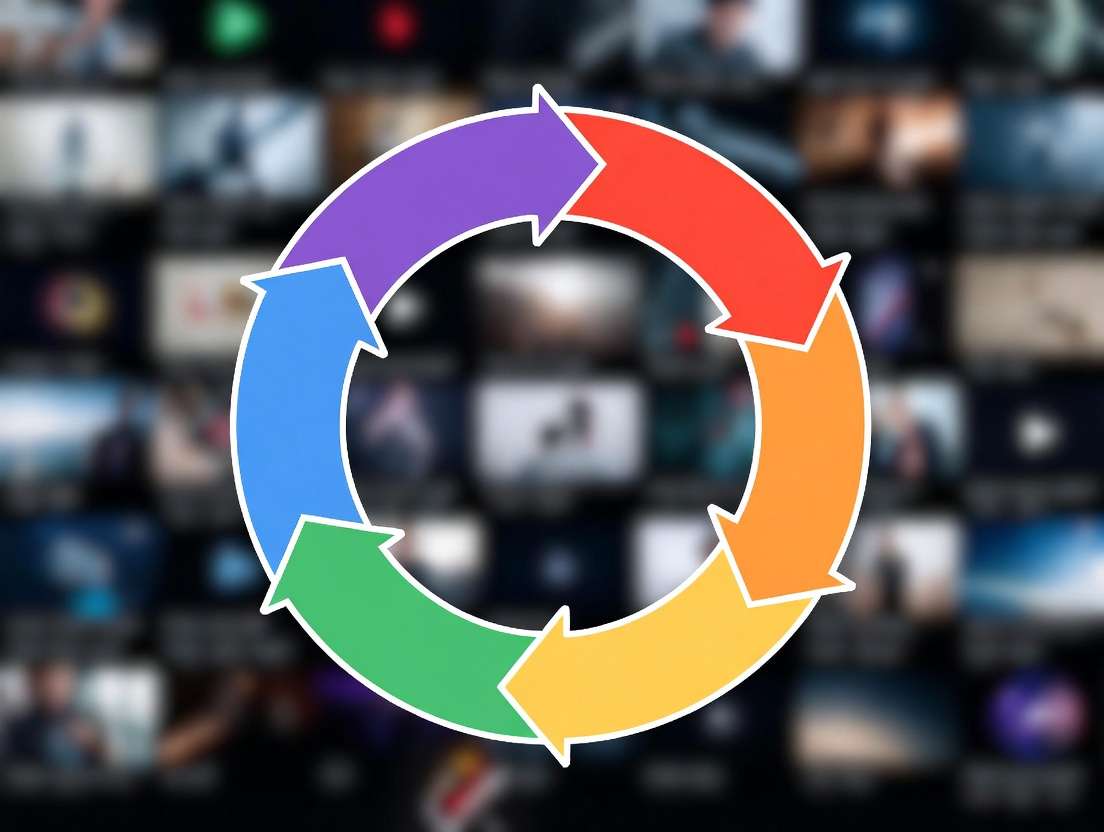
The six steps described in this series form a continuous loop:
- Define clear goals and hypotheses
- Detect emerging opportunities and patterns
- Design strategies as experiments
- Produce variations efficiently
- Test ideas in the market
- Convert results into system-level learning
Then the cycle begins again.
Each iteration reduces uncertainty.
Each iteration improves decision quality.
Each iteration strengthens the system.
Why this matters
The future of service businesses will not be defined by automation alone.
It will be defined by how well humans and machines learn together.
Teams that treat content as isolated output will always struggle to keep up.
Teams that treat content as a structured learning system will improve continuously.
And over time, that difference compounds.
Not just into better content.
But into entirely different kinds of organizations.
This post is part 6 of the series How AI-Native Agencies Will Actually Work.
Subscribe to AI in Action by AIX — a weekly newsletter that explores what it really takes to put AI into production and make it work inside real organizations
Let’s talk
Whether you’re looking for expert guidance on AI transformation or want to share your AI knowledge with others, our network is the place for you. Let’s work together to build a brighter future powered by AI.